Table of contents
At Allbrass, we are industry leaders in the precise and demanding art of metalworking, with a particular focus on hot forging serial parts. Our reputation is built on decades of expertise, advanced technology, and a commitment to delivering the highest quality components. But what exactly is hot forging, and how does this sophisticated process work? In this blog, we’ll walk you through the hot forging process and explain how we manufacture serial parts with precision and reliability.
Hot forging is a specialized metal shaping process in which metal is heated to an extremely high temperature and then subjected to intense pressure to form it into the desired shape. This process enhances the metal’s malleability, enabling it to be molded into complex forms without compromising its integrity. The result is a component that is not only precisely shaped but also structurally robust, meeting the stringent demands of modern engineering.
1. Material selection and preparation
The foundation of the hot forging process begins with selecting the appropriate metal for the specific application. We use the material; brass alloys. The selected metal is then cut to the exact dimensions required for forging. Our sawing process is fully automated. The bar material is placed in large bundles, after which the saw operates automatically. Through precise settings (length & weight) per product, minimal material loss is ensured. Our sawing technologies are designed not only to ensure the highest product quality, but also to minimize environmental impact. During sawing, chips are released, which we carefully collect and reuse in our blasting machines.
2. Heat treatment in forging
The next step involves heating the metal to a temperature above its recrystallization point, typically between 700°C and 800°C. This precise heat treatment is critical to achieving the optimal plasticity of the metal, which allows for the complex shaping required in the forging process. At this stage, the metal is prepared to undergo significant transformation without the risk of fractures or other defects.
3. Precision shaping
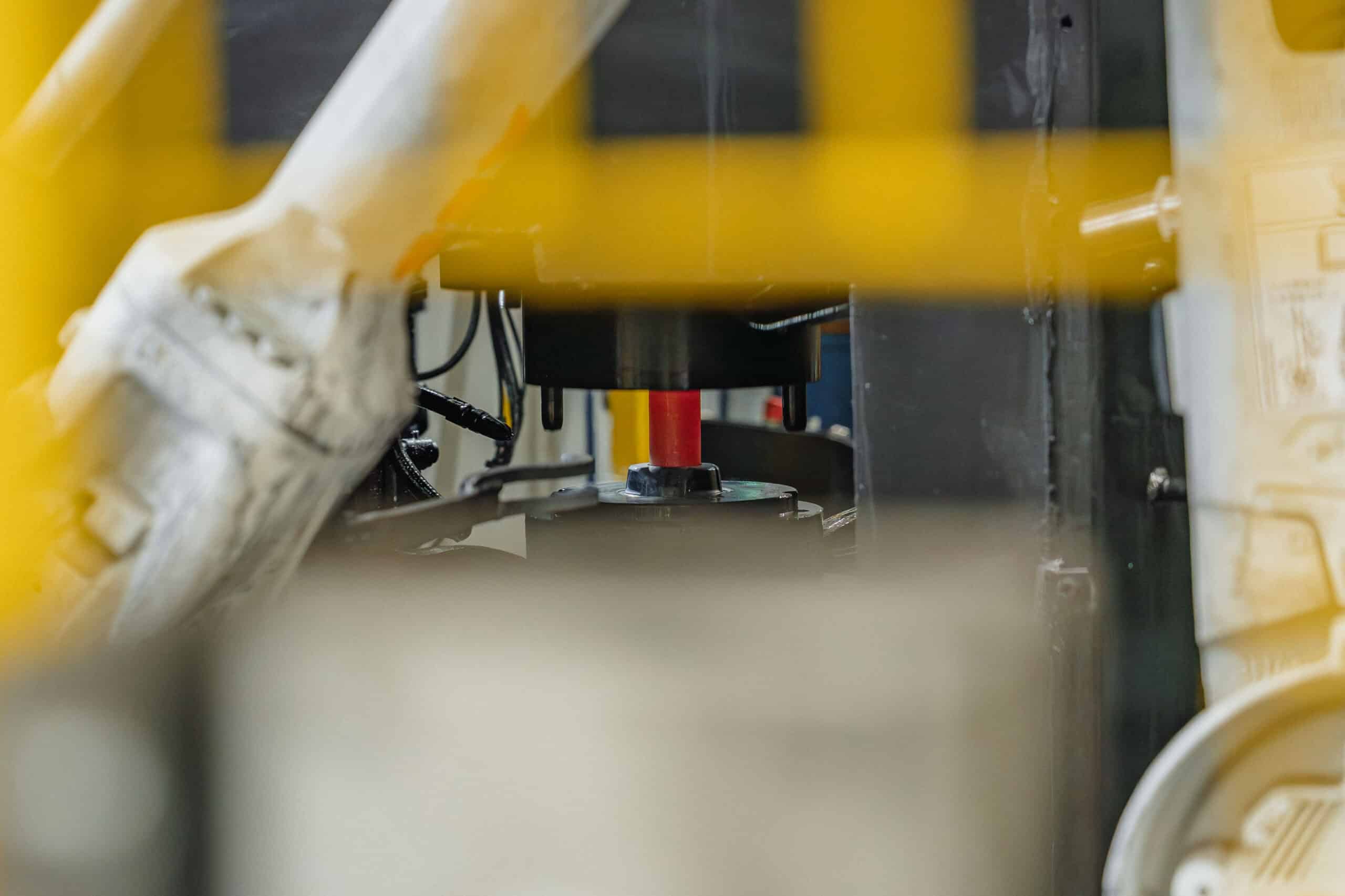
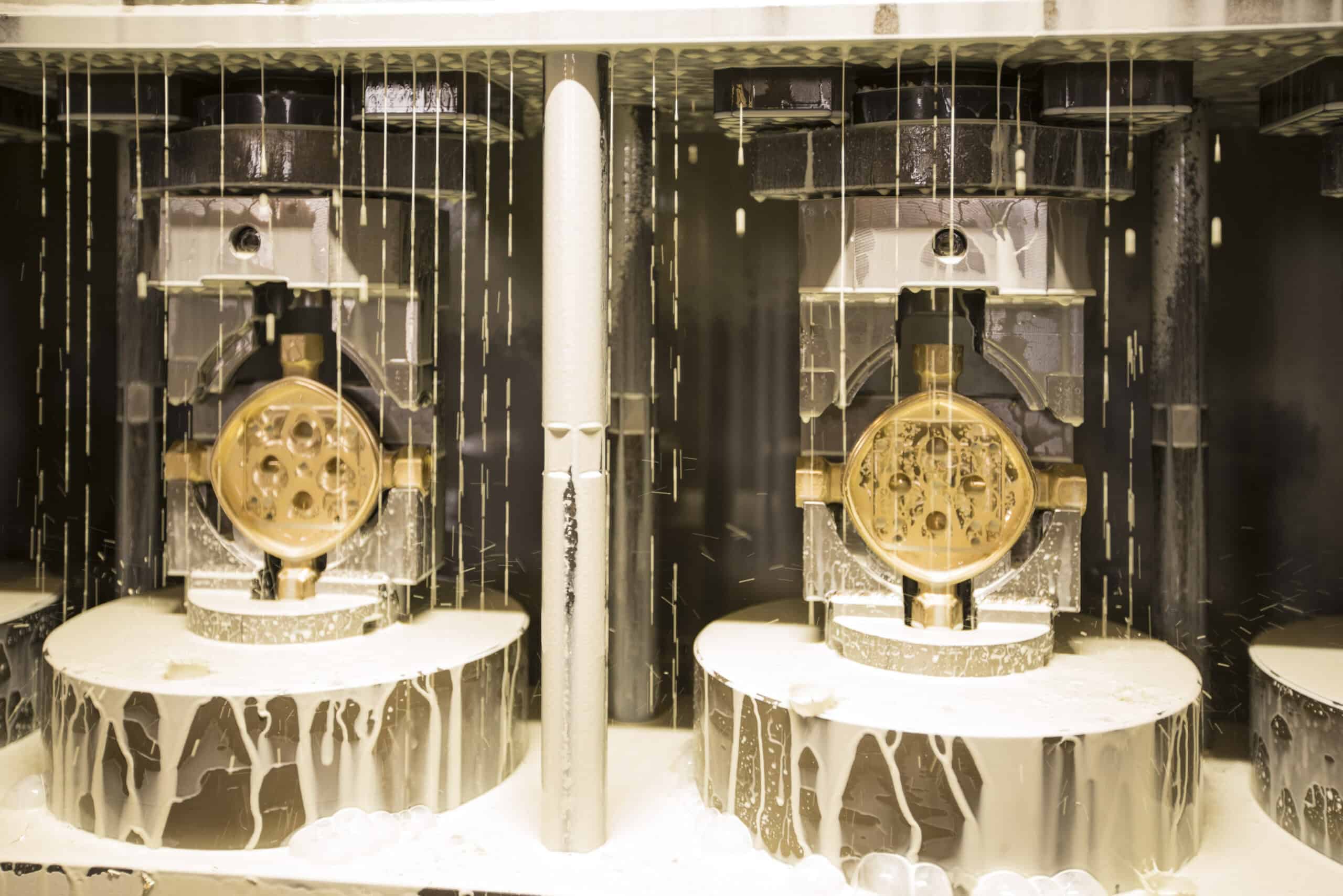
Once the metal has reached the required temperature, it is transferred to a hot forging press. Here, under immense pressure (until 750.000 kg), the metal is forced into a die that imparts the exact shape of the final component. This step is the core of the hot forging process. The combination of precise temperature control and high-pressure forging ensures that the resulting part is not only accurate in its dimensions but also exhibits enhanced mechanical properties, making it ideal for demanding applications.
4. Controlled cooling
Following the forging process, the newly shaped part undergoes controlled cooling. Depending on the desired characteristics of the final product, this cooling process can vary-ranging from slow, uniform cooling to rapid quenching. Each method is carefully chosen to achieve the specific mechanical properties required, such as toughness, hardness, or ductility.
5. Processing and finishing of forged parts
After forging, the parts are cooled on a cooling belt, where the degree of cooling depends on the product and can be achieved by air or water cooling. Next, a big part of pressed products undergo surface treatment, such as blasting or ball polishing, to clean and finish the surface. Blasting uses brass sawdust to degrease the surface and change colour, while ball polishing with R.V.S. balls provides a shiny and degreased surface. Finally, pressed parts are machined on customer request.
6. Inspection and quality control
During and after the forging and machining processes, the parts are regularly inspected for surface quality and any defects, and dimensional accuracy is checked. This helps ensure that the produced parts meet the required specifications and quality standards. To start production, there is a mandatory release. During production, there is a new inspection measurement every hour. Through these inspections and quality controls, quality is ensured, and we always ensure a perfect service level.
Hot forging offers numerous advantages, particularly in the production of serial parts. The process significantly enhances the strength and durability of the metal, ensuring that each component can withstand demanding operational conditions. Additionally, hot forging allows for the creation of complex shapes with a high degree of accuracy and repeatability. This efficiency not only reduces manufacturing costs but also ensures that large volumes of parts can be produced with consistent quality.

At Allbrass we don’t just produce parts; we forge excellence. The hot forging process, backed by our extensive expertise, enables us to deliver serial parts that set the benchmark for quality and reliability. By controlling every step of the process, we ensure that each component we produce fully harnesses the advantages of hot forging, meeting the exacting demands of our clients across various industries!