

In the sanitary industry, there is a growing demand for components that meet high standards in terms of strength, dimensional accuracy, and durability.
Manufacturing methods such as casting, machining, and hot forging each have their own area of application.
For many brass components produced in large quantities, hot forging offers significant advantages in mechanical properties, material utilization, and production efficiency.
During the hot forging process, brass is heated to approximately 650 °C to 750 °C and deformed under high pressure in a die. This results in a dense material structure with favorable mechanical properties.
The main advantages are:
For sanitary components, a precise fit is essential to ensure a reliable seal and trouble-free assembly. Hot forging offers several advantages in this regard:
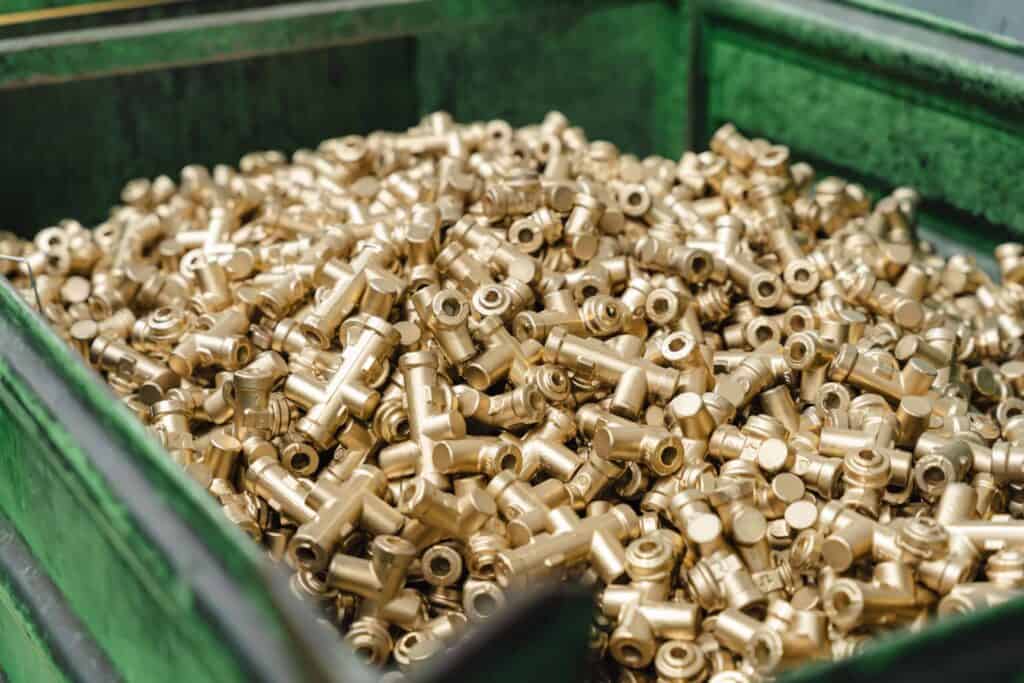
Hot forging is one of the so-called near-net-shape manufacturing techniques. The component leaves the die already very close to its final geometry. This offers several advantages:
Machining remains an excellent production method for small batches, complex operations, and parts requiring extremely high precision. However, for larger production volumes, hot forging often offers clear advantages.
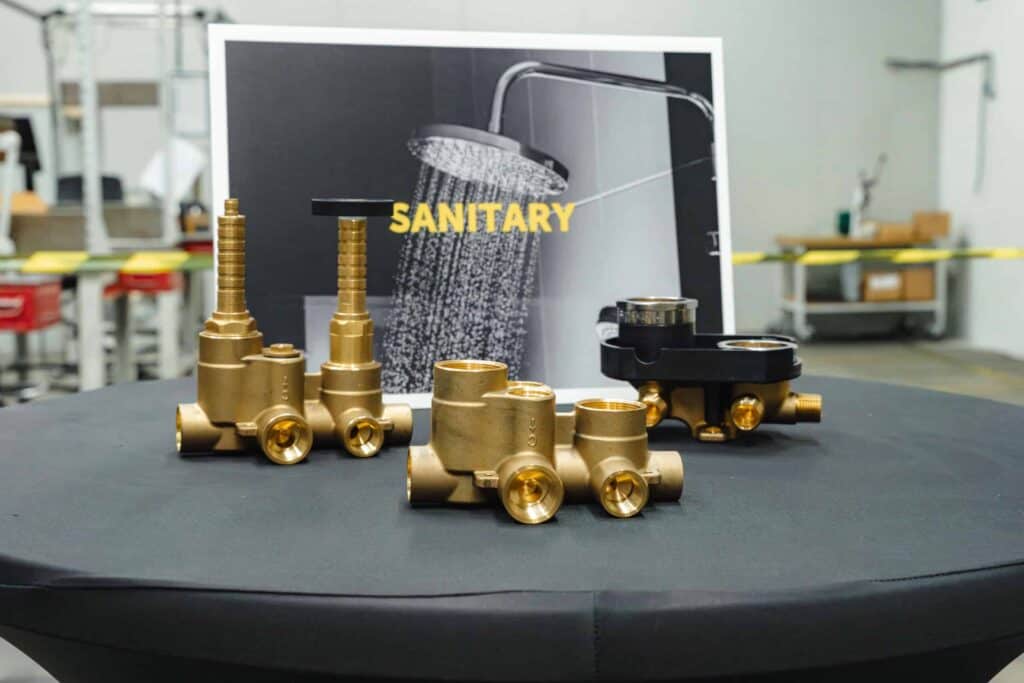
Hot forging is widely used for manufacturing brass components such as:
• faucet bodies;
• couplings;
• valve bodies;
• fittings;
• connection pieces;
• components for mixing faucets and shut-off valves.
For these applications, strength, dimensional stability, and reliable sealing performance are essential.
Hot forging is a proven and widely used production method for high-quality brass sanitary components. Thanks to the combination of a favorable material structure, high dimensional accuracy, efficient material utilization, and limited post-processing requirements, it is an attractive choice for many applications. Particularly in medium and high-volume production runs, hot forging offers an excellent balance between quality, reliability, and cost-efficiency.


